The Essential Guide to Intracept CPT Codes
Understanding the Intracept Procedure for Vertebrogenic Pain
 Chronic low back pain can be debilitating, often impacting daily life for millions. For those suffering from vertebrogenic pain, the Intracept procedure offers a promising, minimally invasive solution. However, for healthcare providers and their teams, ensuring patients can access this innovative treatment means successfully navigating a complex landscape of medical coding, billing, and insurance reimbursement.
We understand these administrative problems can be daunting. Accurate coding and successful reimbursement are not just about finances; they are critical for patient access to care. This requires a precise understanding of the Current Procedural Terminology (CPT) codes, International Classification of Diseases (ICD-10) diagnosis codes, and intricate payer-specific guidelines.
In this essential guide, we aim to explain the billing and coding process for the Intracept procedure. We will explore the procedure itself, break down the primary and add-on CPT codes, and clarify the necessary ICD-10 codes for justification. We’ll also dive into Medicare reimbursement rates for both facility and physician services, and guide you through the complexities of prior authorization and coverage criteria for various insurance plans, including Medicare Advantage, TRICARE, Workers’ Compensation, and Motor Vehicle Accident insurance. For those seeking specific guidance, such as for Fairmont Intracept pain management, this comprehensive overview will lay a strong foundation.
Our goal is to equip you with the knowledge needed to ensure smooth administrative processes and timely patient access to this important pain relief option.
Chronic low back pain is a pervasive issue, often stemming from various sources within the complex structure of the spine. Among these, vertebrogenic pain, which originates from degenerative changes in the vertebral endplates, has emerged as a distinct and treatable condition. The Intracept Intraosseous Nerve Ablation System, developed by Relievant Medsystems (now part of Boston Scientific), offers a targeted, minimally invasive treatment for this specific type of chronic low back pain.
The Intracept procedure involves the ablation of the basivertebral nerve (BVN) within the vertebral body. This nerve transmits pain signals from the damaged vertebral endplates. By using radiofrequency (RF) energy to ablate, or essentially “turn off,” these nerves, the procedure aims to interrupt the pain pathway and provide lasting relief. The procedure is typically performed in an outpatient setting, allowing patients to return home the same day.

The mechanism behind vertebrogenic pain is often linked to Modic changes visible on an MRI. These changes indicate inflammation, edema, or fatty degeneration within the vertebral bone marrow adjacent to the endplates. When these endplates are damaged, the basivertebral nerve becomes sensitized, leading to chronic low back pain. The Intracept procedure directly addresses this source of pain, providing a targeted intervention where conservative treatments may have failed.
Clinical Indications for Intracept
Identifying appropriate candidates for the Intracept procedure is crucial for both clinical success and reimbursement. The indications for use are specific and require careful patient selection, as outlined by the manufacturer and various payer policies. Generally, the Intracept procedure is intended for patients who meet the following criteria:
- Chronic Low Back Pain: The patient must have experienced chronic low back pain for at least six months. This duration signifies that the pain is persistent and not an acute episode.
- Failed Conservative Care: Prior to considering Intracept, patients must have failed to respond to at least six months of conservative care. This typically includes treatments such as physical therapy, medications (e.g., NSAIDs, muscle relaxants), chiropractic care, and injections. Documenting the specific conservative treatments attempted and their lack of efficacy is vital.
- MRI Findings: Crucially, patients must present with specific MRI findings consistent with Type 1 or Type 2 Modic changes at the vertebral endplates.
- Modic Type 1 changes indicate active inflammation and edema, often associated with acute pain.
- Modic Type 2 changes represent fatty degeneration of the bone marrow, typically seen in more chronic conditions. These MRI findings provide objective evidence of vertebrogenic pain and are a cornerstone for medical necessity.
- Target Vertebrae: The procedure targets the basivertebral nerves of the L3 through S1 vertebrae. These are the most common sites for vertebrogenic pain in the lumbar spine. For more detailed information on the indications for use, providers can refer to the official Relievant resources, such as those found on the Boston Scientific website, including the Relievant Reimbursement Resources.
Contraindications and Patient Safety
While the Intracept procedure offers significant benefits, it is not suitable for all patients. A thorough evaluation of contraindications is essential to ensure patient safety and appropriate treatment selection. Key contraindications include:
- Skeletal Immaturity: The procedure is generally contraindicated in skeletally immature patients, typically those ≤ 18 years of age.
- Active Systemic or Local Infection: Any active infection could lead to serious complications if the procedure is performed.
- Pregnancy: The procedure is contraindicated in pregnant patients due to potential risks to the fetus and the use of imaging.
- Active Implantable Pulse Generators: Patients with devices such as pacemakers or implantable cardioverter-defibrillators (ICDs) are typically excluded due to potential interference with the radiofrequency energy.
- Severe Cardiac or Pulmonary Compromise: Patients with significant heart or lung conditions may not tolerate the procedure or anesthesia well.
- Proximity to Sensitive Structures: The target ablation zone must be at least 10 mm away from the vertebral foramen or other sensitive structures to avoid nerve damage or other complications.
Adherence to these indications and contraindications is paramount for patient safety and successful outcomes, as well as for meeting payer coverage criteria.
A Comprehensive Guide to Intracept CPT and ICD-10 Codes
Accurate coding is the bedrock of successful reimbursement for any medical procedure, and the Intracept procedure is no exception. Healthcare providers must be meticulous in selecting the correct Current Procedural Terminology (CPT) codes to describe the services rendered and the appropriate International Classification of Diseases, Tenth Revision (ICD-10) codes to justify the medical necessity of the procedure. These codes, established by the American Medical Association (AMA), form the universal language of medical billing.

Primary and Add-On CPT Codes
The AMA has established specific Category I CPT codes for the Intracept procedure, which became effective on January 1, 2022. These codes are crucial for billing and reimbursement:
- CPT 64628: Thermal destruction of basivertebral nerve, intraosseous, first two vertebral bodies, lumbar or sacral, including all imaging guidance.This is the primary code used for the Intracept procedure, covering the ablation of the basivertebral nerves in the first two vertebral bodies treated (e.g., L3-L4).
- A significant detail is that this code includes all imaging guidance (such as fluoroscopy or CT), meaning separate billing for imaging is not appropriate.
- CPT code 64628 has a global period of 10 days, indicating that certain follow-up care within this period is bundled into the procedure’s reimbursement.
- CPT +64629: Thermal destruction of basivertebral nerve, intraosseous, each additional vertebral body, lumbar or sacral, including all imaging guidance (List separately in addition to code for primary procedure).This is an add-on code and must always be reported in conjunction with CPT 64628. It is used when more than two vertebral bodies are treated during the same session (e.g., if L3, L4, and L5 are treated, you would bill 64628 once and +64629 once).
- Like 64628, it includes all imaging guidance.
- Medically Unlikely Edits (MUEs) may apply to CPT +64629. For instance, some payers, including Medicare, may have an MUE of 3 units, meaning claims for more than three additional vertebral bodies (i.e., a total of five vertebral bodies) might be denied.
Understanding these codes and their nuances is critical for accurate claims submission. The Relievant Reimbursement Guide provides comprehensive details on these codes and their application, which is updated annually to reflect any changes in reimbursement policies.
Justifying the Procedure with ICD-10 Diagnosis Codes
CPT codes describe what was done, while ICD-10 diagnosis codes explain why it was done. For the Intracept procedure, selecting the correct ICD-10 codes is paramount to demonstrating medical necessity and securing reimbursement. The diagnosis must clearly align with the clinical indications for the procedure, particularly the presence of vertebrogenic pain.
Common ICD-10 codes used to justify the Intracept procedure include:
- M54.51 (Vertebrogenic low back pain): This is the most specific and preferred diagnosis code when the pain is clearly identified as originating from the vertebral endplates, supported by Modic changes on MRI.
- M54.50 (Low back pain, unspecified): While less specific, this code may be used in some contexts, but it’s always better to use a more precise diagnosis if available.
- M47.816 (Spondylosis without myelopathy or radiculopathy, lumbar region): This code indicates degenerative changes in the lumbar spine, which can be associated with vertebrogenic pain.
- M47.817 (Spondylosis without myelopathy or radiculopathy, lumbosacral region): Similar to M47.816, but specifically for the lumbosacral area.
- M51.36 (Other intervertebral disc degeneration, lumbar region): Can be used if disc degeneration is a contributing factor to the vertebrogenic pain.
- M51.37 (Other intervertebral disc degeneration, lumbosacral region): Similar to M51.36, but for the lumbosacral area.
It is crucial for providers to ensure that the patient’s medical record thoroughly supports the chosen ICD-10 diagnosis, particularly the presence of Modic changes and the failure of conservative treatments, as these are key criteria for coverage. The Relievant Reimbursement Guide also offers guidance on appropriate ICD-10 codes.
The Reimbursement Landscape: Medicare Rates for Fairmont Pain Management Intracept
Understanding the financial aspects of the Intracept procedure is critical for healthcare practices. Reimbursement rates can vary significantly depending on the payer (e.g., Medicare, private insurance), the setting in which the procedure is performed (e.g., Hospital Outpatient Department vs. Ambulatory Surgical Center), and even geographic location. For practices offering Fairmont Intracept pain management, navigating these nuances is key to financial sustainability and patient access.
Medicare, as a major payer, sets benchmarks that often influence other insurers. Its reimbursement structure distinguishes between facility fees (paid to the hospital or ASC) and physician fees (paid to the performing physician).

Facility Reimbursement: HOPD vs. ASC
The choice of where to perform the Intracept procedure—a Hospital Outpatient Department (HOPD) or an Ambulatory Surgical Center (ASC)—has significant implications for facility reimbursement.
- Hospital Outpatient Department (HOPD):In HOPDs, Medicare payment for the Intracept procedure (CPT codes 64628 and +64629) is typically based on Ambulatory Payment Classifications (APCs). CPT codes 64628 and +64629 are assigned to APC 5115 (Level 5 Spinal Procedures).
- CPT 64628 is designated as a device-intensive procedure by CMS. This means a significant portion of the payment is attributed to the cost of the device itself.
- For device-intensive procedures in HOPDs, CMS requires facilities to report HCPCS code C1889 (Catheter, extravascular, therapeutic, for radiofrequency ablation) along with Revenue code 0278 (Implants, other) to account for the device cost. Medicare may deny claims if these device-associated charges are not reported.
- The Medicare national average payment for CPT 64628 in an HOPD is approximately $12,552. This rate is subject to geographic adjustments.
- Ambulatory Surgical Center (ASC):In ASCs, the payment for the Intracept procedure is generally bundled, meaning the device cost is included within the overall reimbursement for the procedure. ASCs do not typically report HCPCS code C1889 separately to CMS.
- The Medicare national average payment for CPT 64628 in an ASC is approximately $9,396. This rate is also subject to geographic adjustments.
The key difference in reimbursement between HOPDs and ASCs lies in how the device cost is accounted for, leading to different total payment amounts. Providers must be aware of these distinctions when planning where to perform the procedure. Further details on facility coding and payment can be found in the Relievant Reimbursement Guide.
Medicare Physician Reimbursement Rates
Physician reimbursement for the Intracept procedure is determined by Medicare’s Physician Fee Schedule, which is based on Relative Value Units (RVUs). These RVUs reflect the work, practice expense, and malpractice expense associated with performing a procedure.
- RVU Components:Work RVUs: Account for the physician’s time, effort, and skill.
- Practice Expense RVUs: Cover overhead costs like staff salaries, office rent, and equipment.
- Malpractice RVUs: Reflect the cost of professional liability insurance.
- Payment Calculation: The total RVUs for a code are multiplied by a conversion factor (updated annually by CMS) and adjusted by the Geographic Practice Cost Index (GPCI) to determine the final payment rate for a specific location.
- National Average Payment Rates (2024, facility setting):For CPT 64628 (first two vertebral bodies):
- Work RVUs: 7.15
- Total RVUs: 12.34
- Medicare national average payment rate: Approximately $399.16
- For CPT +64629 (each additional vertebral body):
- Work RVUs: 3.77
- Total RVUs: 5.82
- Medicare national average payment rate: Approximately $188.26
These rates are for services performed in a facility setting (HOPD or ASC), as there is no office payment assigned for these services. These are national averages, and actual payments will vary based on the specific MAC, GPCI for the service area, and other factors. Providers should consult the latest Physician Fee Schedule and their local MAC for precise rates.
Navigating Payer Coverage and Prior Authorization
Securing coverage and reimbursement for the Intracept procedure extends beyond Medicare to a diverse array of private insurers, Medicare Advantage plans, and other government programs. Each payer has its own set of policies, medical necessity criteria, and prior authorization processes, making this aspect particularly challenging for healthcare providers.
Coverage Beyond Traditional Medicare
- Medicare Advantage Plans: These plans are offered by private companies approved by Medicare. While they must cover everything original Medicare covers, their specific coverage criteria for procedures like Intracept may vary based on local coverage determinations (LCDs) issued by Medicare Administrative Contractors (MACs) in their region. Providers must consult the applicable LCDs to understand the coverage criteria.
- Commercial Insurers: Coverage policies for the Intracept procedure vary significantly among private insurers. Many major commercial payers, such as Humana, Anthem Blue Cross Blue Shield, and Cigna Healthcare, have established positive coverage policies, recognizing the clinical benefits of the procedure. However, it is essential to verify coverage with each insurer and follow their specific guidelines, as policies can differ in terms of indications, required documentation, and prior authorization steps. Relievant Medsystems provides resources on specific insurer policies.
- TRICARE Guidelines: TRICARE, the healthcare program for uniformed service members, retirees, and their families, has specific guidelines for basivertebral nerve ablation. Coverage typically requires:
- Chronic low back pain for at least six months.
- Failure of at least three months of conservative management.
- MRI-confirmed Modic Type 1 or Type 2 changes.
- A positive response (at least 50% pain reduction) to diagnostic medial branch blocks. Providers should consult TRICARE’s specific policy documents for the most up-to-date information, such as the TRICARE West RF Denervation policy.
- Workers’ Compensation and Motor Vehicle Accident Injury Insurance: The Intracept procedure may be covered under Workers’ Compensation or Motor Vehicle Accident (MVA) injury insurance if the injury is directly related to a work accident or motor vehicle collision, respectively. Coverage is contingent upon demonstrating medical necessity and adherence to the specific state or plan guidelines. Thorough documentation linking the injury to the pain and the failure of other treatments is crucial. Providers should refer to state-specific Workers’ Compensation guides for detailed requirements.
The Prior Authorization Process for Fairmont Pain Management Intracept
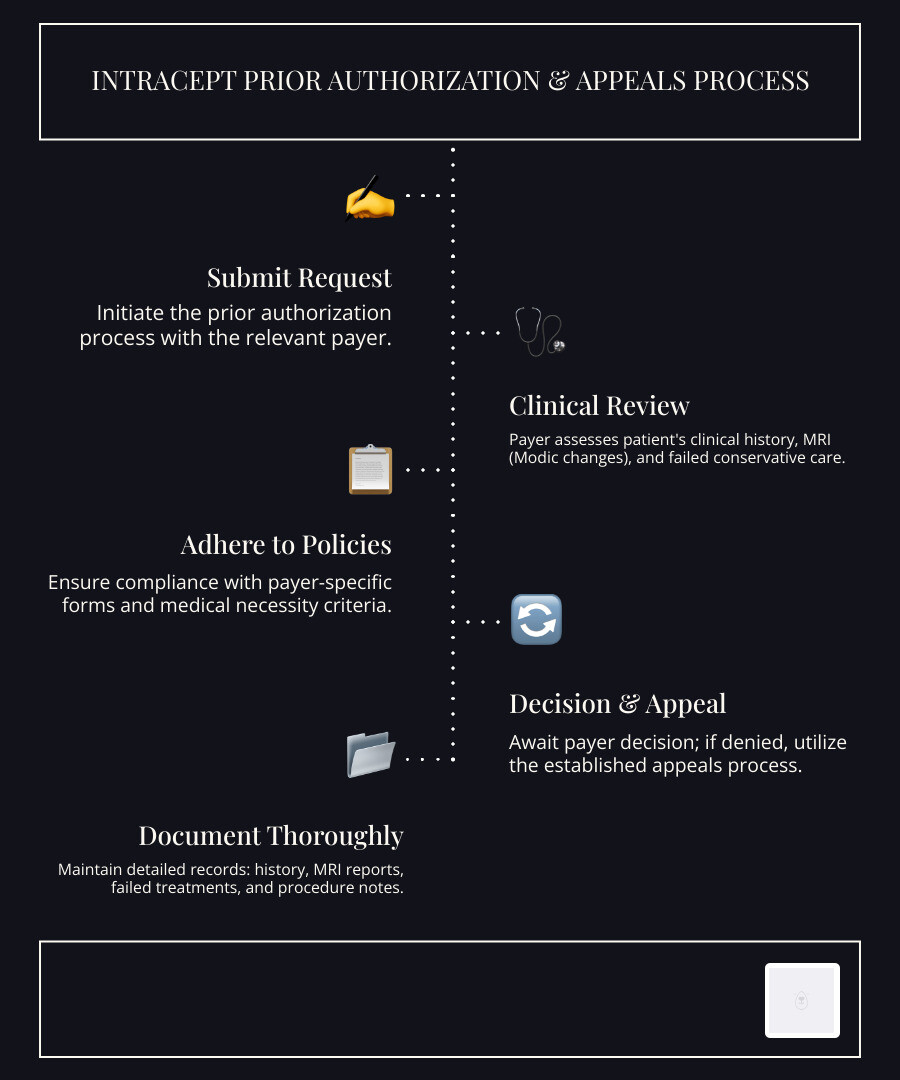
Prior authorization (PA) is a critical, often complex, step to ensure that the Intracept procedure is covered by a patient’s insurance plan. It involves demonstrating to the insurance company that the procedure is medically necessary based on their specific criteria.
The process generally involves:
- Submission of Request: The provider’s office submits a prior authorization request to the insurance company. This typically includes a standardized form provided by the payer.
- Clinical Documentation Review: The payer reviews the submitted clinical documentation to determine if the patient meets their medical necessity criteria. This is where comprehensive and accurate records are vital.
- Payer-Specific Forms and Criteria: Each insurance company may have unique forms and specific clinical criteria that must be met. Providers should familiarize themselves with these requirements for each major payer they work with.
- Decision: The payer will issue an approval or denial. If approved, the procedure can proceed. If denied, there is typically an appeals process.
Navigating these complexities can be time-consuming. For local guidance and support with prior authorization for procedures like Intracept, especially for those in specific regions, resources such as those focused on Fairmont Intracept pain management can be invaluable. Companies like GoHealthcare Practice Solutions also offer comprehensive support to streamline this process and ensure successful authorization.
Essential Documentation to Support a Fairmont Pain Management Intracept Request
Accurate and comprehensive documentation is the single most critical factor for successful prior authorization and reimbursement. Without it, even a medically necessary procedure may be denied coverage. Key documentation components include:
- Patient’s Clinical History: Detailed records of the patient’s chronic low back pain, including onset, duration, severity, and impact on daily activities.
- MRI Reports Showing Modic Changes: Objective evidence of Type 1 or Type 2 Modic changes at the vertebral endplates is mandatory. The report should clearly state the presence and type of these changes and their location (L3-S1).
- Documentation of Failed Conservative Treatments: A thorough record of all conservative therapies attempted, including:
- Type of treatment: e.g., physical therapy, chiropractic care, medications (NSAIDs, opioids, muscle relaxants), epidural steroid injections, facet joint injections.
- Duration: Evidence that each conservative treatment was tried for an appropriate duration (typically at least six months in aggregate, or three months for TRICARE).
- Response: Documentation of the patient’s response to each treatment, indicating that they provided insufficient or temporary relief.
- Detailed Procedure Notes: If the procedure is performed, the operative report must clearly document the vertebral bodies treated, the use of imaging guidance, and any other relevant surgical details.
- Correspondence with Insurers: Maintain a meticulous record of all interactions with the insurance company, including submission dates, reference numbers, and any communication regarding approval or denial.
Ensuring that the documentation reflects the patient’s condition, the medical necessity of the procedure, and adherence to payer guidelines is crucial for avoiding delays and denials.
Key Takeaways and Frequently Asked Questions
Navigating the intricacies of billing, coding, and reimbursement for the Intracept procedure can seem overwhelming. However, by understanding the core components and adhering to best practices, healthcare providers can streamline their processes and ensure appropriate access to this innovative treatment for their patients.

Here are some key takeaways and frequently asked questions to help solidify your understanding:
What are the primary CPT codes for the Intracept procedure?
The primary CPT codes for the Intracept procedure are 64628 for the thermal destruction of the basivertebral nerve in the first two vertebral bodies, and +64629 as an add-on code for each additional vertebral body treated. Both codes explicitly include all imaging guidance, meaning separate billing for fluoroscopy or CT guidance is not appropriate. CPT 64628 also carries a 10-day global period.
Why are Modic changes on an MRI essential for Intracept coverage?
Modic changes (Type 1 or Type 2) on an MRI are absolutely essential for Intracept coverage because they provide objective evidence of vertebral endplate damage, which is the anatomical source of vertebrogenic pain. These findings confirm the specific etiology of the patient’s chronic low back pain, justifying the medical necessity of a targeted intervention like the Intracept procedure to payers. Without documented Modic changes, it is difficult to prove that the pain is vertebrogenic, and coverage is likely to be denied.
What is the main difference in billing for Intracept in an HOPD versus an ASC?
The main difference in billing for the Intracept procedure between a Hospital Outpatient Department (HOPD) and an Ambulatory Surgical Center (ASC) lies in how the device cost is reported and reimbursed. In an HOPD, CPT 64628 is considered device-intensive, and facilities are typically required to report the device cost separately using HCPCS code C1889 with Revenue code 0278. This leads to a higher national average payment for the HOPD setting (approximately $12,552). In contrast, in an ASC, the payment for the Intracept procedure is generally bundled, meaning the device cost is included within the overall procedure reimbursement. ASCs do not typically report C1889 separately, and their national average payment is lower (approximately $9,396). This distinction significantly impacts the total reimbursement received by the facility.
By maintaining accurate coding, thorough documentation, and a clear understanding of payer policies and prior authorization requirements, healthcare providers can successfully steer the reimbursement landscape for the Intracept procedure, ensuring that patients receive timely access to this effective treatment option.